Conjunction (Basic ㊦ 480)
A subordinate conjunction which marks a condition that brings about an uncontrollable event or state.
Equivalent: If; when
| {V/Adjective (い/な) Noun+copula} informal nonpast | と | |
| 話すと | If someone talks | |
| 高いと | If something is expensive | |
| 静かだと | If something is quiet | |
| 先生だと | If someone is a teacher |
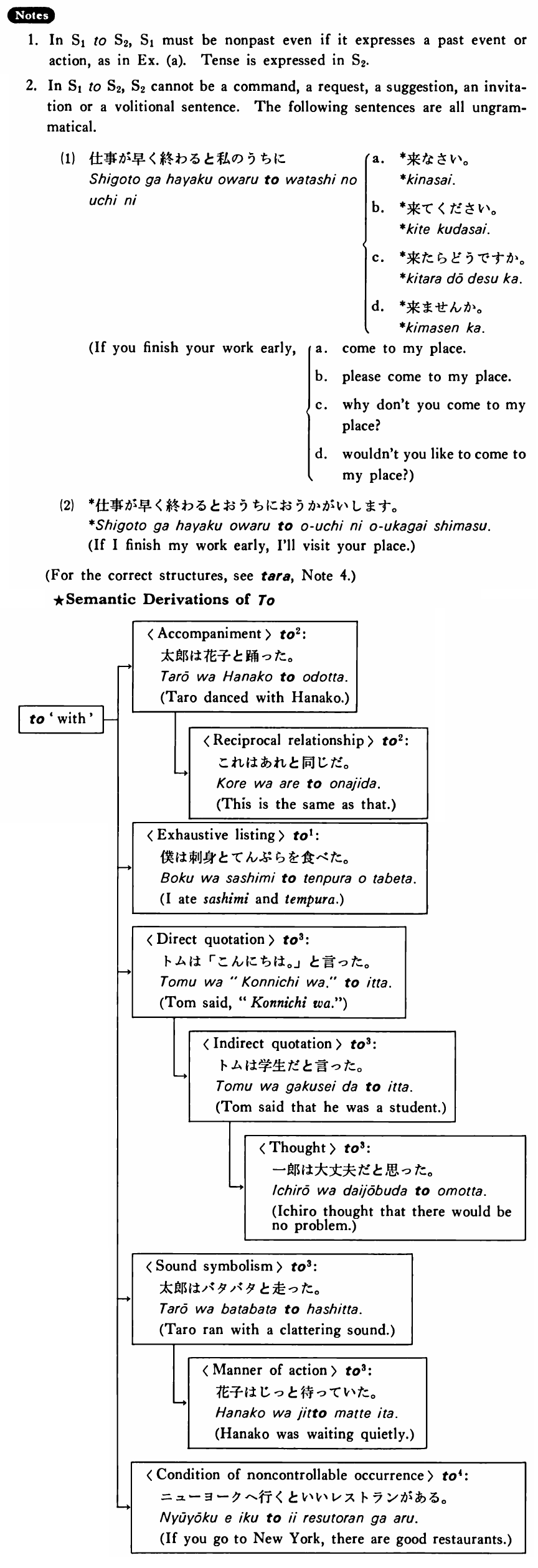
1. In Sentence1とSentence2, Sentence1 must be nonpast even if it expresses a past event or action, as in Example (a). Tense in expressed in Sentence2.
2. In Sentence1とSentence2, Sentence2 cannot be a command, a request, a suggestion, an invitation or a volitional sentence. The following sentences are all ungrammatical.
(1)
| ⎧a. | 来なさい。 | |
| 仕事が早く終わると私のうちに | ⎨b. | 来てください。 |
| ⎪c. | 来たらどうですか。 | |
| ⎩d. | 来ませんか。 |
| ⎧a. | come to my place. | |
| If you finish your work early, | ⎨b. | please come to my place. |
| ⎪c. | why don't you come to my place? | |
| ⎩d. | wouldn't you like to come to my place? |
(For the correct structures, see たら, Note 4.)
★Semantic Derivations of と
| と 'with'― | →[Accompaniment] と2 太郎は花子と踊った。 Taro danced with Hanako. | ||
| ⤷[Reciprocal relationship] と2 これはあれと同じだ。 This is the same as that. | |||
| と 'with'― | →[Exhaustive listing] と1 僕は刺身と天ぷらを食べた。 I ate sashimi and tempura. | ||
| と 'with'― | →[Direct quote] と3 トムは「こんにちは。」と言った。 Tom said, "Konnichi wa". | ||
| ⤷[Indirect quote] と3 トムは学生だと言った。 Tom said that he was a student. | |||
| ⤷[Thought] と3 一郎は大丈夫だと思った。 Ichiro thought that there would be no problem. | |||
| と 'with'― | ⤷[Sound symbolism] と3 太郎はバタバタと走った。 Taro ran with a clattering sound. | ||
| ⤷[Manner of action] と3 花子はじっと待っていた。 Hanako was waiting quietly. | |||
| と 'with'― | →[Condition of noncontrollable occurence] と4 ニューヨークに行くといいレストランがある。 If you go to New York, there are good restaurants. |